

If you've spent any time in the world of the Science of Reading, you've likely come across one of its most beloved visuals: Scarborough's Reading Rope. Created by researcher Hollis Scarborough in 2001, this illustration captures something beautifully true about reading — that it isn't one single skill, but many threads working together, gradually braiding into something strong, fluent, and automatic.
What makes the Reading Rope so powerful isn't just the metaphor. It's the clarity it offers educators: every strand matters. A reader who struggles with any one of them will feel it. And a program worth its salt needs to address all of them.
That's exactly what Structured Literacy with E.A.S.E. was built to do.
A Quick Tour of the Reading Rope
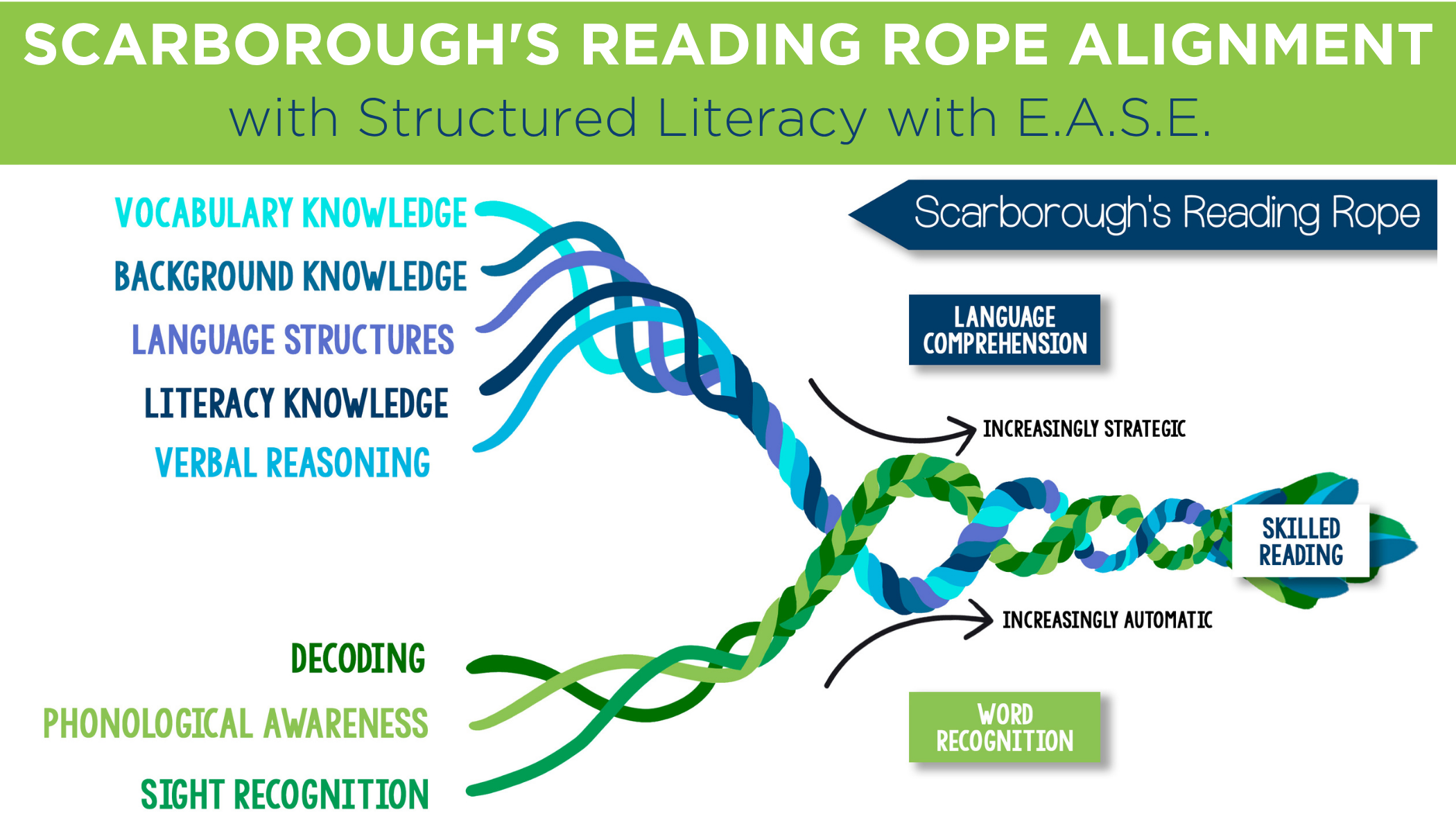
Scarborough's rope is made up of two main groups of strands that weave together over time.
The Word Recognition strands sit on the lower half of the rope. These are the skills that help readers translate print into words:
- Phonological Awareness — hearing and manipulating the sounds in spoken language
- Decoding — using letter-sound knowledge to read words
- Sight Recognition — automatically recognizing familiar words without having to decode them every time
The Language Comprehension strands make up the upper half. These are the skills that help readers understand what they're reading:
- Background Knowledge — the experiences and information a reader brings to a text
- Vocabulary — knowing what words mean
- Language Structures — understanding grammar, syntax, and how sentences work
- Verbal Reasoning — making inferences, drawing conclusions, thinking critically about text
- Literacy Knowledge — understanding how books, print, and stories are organized
When both groups of strands are strong and tightly woven together, the result is skilled, fluent reading — the whole purpose of the rope.
Here's the beautiful thing: Structured Literacy with E.A.S.E. doesn't just tip its hat to Scarborough's framework. It addresses every single strand, from the very first lesson to the most advanced sequences.
The Lower Strands: Building Word Recognition
Phonological and Phonemic Awareness
The Reading Rope begins here, and so does Structured Literacy with E.A.S.E. The Sound Sequence — the program's very first module — is built around activating the phonological portion of the reading brain before every lesson. If a lesson focuses on the letter f and the sound /f/, the phonological awareness activities highlight that exact sound.
The sequence follows the natural developmental progression research recommends: starting with larger units (syllables, rhymes) before moving to the individual phoneme level. By Sequences 1 and 2, the focus shifts entirely to phonemic awareness — blending and segmenting (and manipulating) individual sounds — because these are the skills most directly connected to learning to read and spell.
For students who find abstract sound work challenging, the program includes multisensory supports like chips and counters to make phonemes visible and concrete.
Decoding
Structured Literacy with E.A.S.E. takes a systematic, synthetic phonics approach — meaning students learn phoneme-grapheme correspondences explicitly and build from those foundations to decode words, phrases, sentences, and full texts. Nothing is left to chance or assumed.
Each three-day lesson cycle layers the learning carefully: Day 1 introduces the skill with multisensory word mapping; Day 2 moves to reading a full decodable text; Day 3 deepens fluency and includes progress monitoring. Scaffolds like teacher modeling, echo reading, and guided practice are woven throughout so no student is left to figure things out alone.
The program also teaches all six syllable types across the sequences — closed, open, vowel-consonant-e, r-controlled, vowel team, and consonant-le — along with syllable division rules and affixes, giving students the tools to tackle multisyllabic words with confidence.
Sight Recognition
Sight recognition in Structured Literacy with E.A.S.E. is developed through orthographic mapping — the research-backed process of connecting sounds to their spellings in memory — rather than rote memorization. This distinction matters enormously.
High-frequency words are introduced systematically, beginning with the thirteen highest-frequency words in the Sound Sequence. Words that share patterns are introduced together; words that are commonly confused are kept apart. Students encounter these words repeatedly across activities, word mapping exercises, and decodable texts, giving their brains the multiple exposures needed to store words automatically.
The Upper Strands: Building Language Comprehension
Background Knowledge
Beginning in Sequence 1 and continuing through Sequence 4, every lesson cycle includes dedicated background knowledge activities. Before students ever open the decodable reader, they're building context: exploring images, listening to a story preview, and engaging in small-group front-loading that introduces key concepts in an accessible way.
On Day 2, "Before Reading Questions" activate prior knowledge and help students form a bridge between what they already know and what they're about to read. For English Language Learners, the program encourages students to engage with concepts in their home language first — a research-supported strategy that reduces cognitive load and builds confidence before transitioning to English.
Vocabulary
Vocabulary instruction in the program is explicit, layered, and grows in sophistication across the sequences. Students define words, explore examples, identify synonyms and antonyms, and connect visuals to meanings. In Sequences 3 and 4, this deepens into morphological analysis — students learn how prefixes and suffixes change the meaning of base and root words, which research shows is one of the most powerful vocabulary-building strategies available.
Language Structures
Scarborough identifies both syntax (how sentences are put together) and semantics (what words and sentences mean) as critical upper strands. Structured Literacy with E.A.S.E. addresses both directly.
Syntax activities cycle through sentence anagrams, sentence elaboration (expanding sentences by answering who, what, where, when, why, and how), and sentence combining. Semantics activities rotate through seven different exercises: synonyms, comparatives and superlatives, homophones, categorization, semantic maps, prepositions, and pronouns. These aren't isolated grammar worksheets — they're woven into the daily lesson flow so students are working with language structure every time they read.
Verbal Reasoning
This is perhaps the richest upper strand in the program. Verbal reasoning in Structured Literacy with E.A.S.E. encompasses an impressive range of comprehension skills: summarizing, story elements, cause and effect, making inferences, identifying theme, distinguishing facts from opinions, understanding author's purpose, interpreting figurative language, and more.
Day 3 lessons bring these skills to life through After Reading Questions, Think-Pair-Share discussions, and inferring activities that push students beyond surface-level reading into genuine analysis. The goal isn't just to check comprehension — it's to build the kind of deep, flexible thinking that makes reading meaningful.
Literacy Knowledge
Print concepts — understanding how books work, how text is organized, the role of punctuation, and the directionality of print — are addressed explicitly in the Sound Sequence and Sequence 1. Students learn everything from how to hold a book to the difference between a sentence and a paragraph, with a gradual release of responsibility built into every lesson. By the time students move into later sequences, these concepts are automatic.
The Rope Pulls Together: Fluency
In Scarborough's model, fluency is what happens when all the strands start working together in harmony. It's the visible sign that word recognition and language comprehension are integrating. Structured Literacy with E.A.S.E. treats fluency not as a separate subject but as something that emerges through all the other instruction — and then gets nurtured deliberately.
Every sequence includes assisted reading strategies (echo reading, choral reading, partner reading, audio-assisted reading), repeated readings of decodable texts, and prosody work that helps students read with the phrasing and expression that signals true understanding. The program also includes a clear framework for determining students' independent, instructional, and frustration reading levels so teachers can match students to texts that build confidence rather than create discouragement.
Why This Matters
Scarborough's Reading Rope is a reminder that no single strand makes a reader. A student can have beautiful phonemic awareness but weak vocabulary and still struggle to comprehend. A student can know every high-frequency word but falter when they haven't been taught to make inferences.
Structured Literacy with E.A.S.E. takes that reminder seriously. Every strand is addressed. Every student is assessed individually and met where they are. And the whole system is built to braid those strands together — lesson by lesson, sequence by sequence — until reading becomes exactly what Scarborough envisioned: strong, fluent, and seemingly effortless.
That's not just good curriculum design. It's what every student deserves.
Structured Literacy with E.A.S.E. is a foundational literacy program developed by Laprea Education, rooted in the Science of Reading. Learn more at www.structuredliteracy.com.
.png?width=960&length=960&name=Untitled%20design%20(54).png)
.png?width=960&length=960&name=Landing%20Page%20Backgrounds%20(8).png)
.png?width=960&length=960&name=Landing%20Page%20Backgrounds%20(27).png)