
.png?width=880&length=880&name=Landing%20Page%20Backgrounds%20(29).png)
Today we are addressing one of our most requested topics, sound walls! Hi there, teacher friends, welcome back to our blog. Are you ready to take your literacy instruction to the next level? Stick with me to learn all about sound walls.
If you have seen any of my recent videos, you would have recognized my incredible sound wall. I have had my sound wall up on the bulletin board behind me for quite some time now, and one comment I’ve been getting a lot lately is, tell me more about this sound wall! So, I thought I’d take a few minutes and talk to you about sound walls and let you know where you can get the one I have!
First, whether your school has adopted a science-of-reading-aligned reading curriculum or not, the research is clear on this; sound walls support literacy instruction. They can make a huge difference in your classroom, but choosing the right sound wall and incorporating it into your instruction isn’t as simple as printing and stapling.
So, today, I’ll share some information about how sound walls help literacy instruction, great tips and activities for using them in your instruction, and what to look for when choosing the sound wall that is best for your learners. Let’s dive in!
Sound Wall Now Available on Amazon
What is a Sound Wall?
So, what exactly is a sound wall? Think of it as your go-to tool for helping students connect sounds, which we call phonemes, to their corresponding letters or letter combinations, which we call graphemes. It’s a super visual and interactive way to boost phonemic awareness and phonics skills.
Sound Wall vs. Word Wall
Now … I get this question a lot: “How is a sound wall different from a word wall?” Great question!
Sound walls focus on sounds and their spellings. They help kids with decoding (reading) and encoding (spelling) by showing the relationship between sounds and letters. You’ll see pictures on sound walls of mouth positions to show how each sound is made, and you’ll see the different ways each sound can be spelled.
Word walls, on the other hand, are all about recognizing and remembering words, especially those tricky sight words that don’t follow regular phonetic patterns. They’re a reference for spelling and writing, and for building vocabulary by displaying words alphabetically or thematically.
In a nutshell, sound walls = sounds and spellings, while word walls = words and vocabulary. In a classroom whose teacher is well-versed in the science behind literacy instruction, it is not uncommon to see sound walls in use.
Benefits of a Sound Wall
So, why should you use a sound wall in your classroom? I’m going to go over some amazing benefits backed by research. Now, for the sake of time, I am not mentioning each study or meta-analysis by name, but I am going to put a list of the resources below that inform my following points. I encourage you to check them out and see how using a sound wall can support literacy instruction. Let’s go through some of the highlights.
- Firstly, sound walls support oral language development. A sound wall provides a visual reference to help students learn and practice how to produce each sound correctly.
- Sound walls also enhance phonemic awareness. Research by Ehri et al. (2001) shows that explicit phonemic awareness instruction significantly improves reading abilities. A sound wall emphasizes individual phonemes, helping students recognize and differentiate various sounds in spoken language.
- Sound walls support phonics instruction. According to the International Dyslexia Association (2002), Research shows that explicit phonics instruction is crucial for all students, especially those with reading difficulties. A sound wall offers clear, visual representations of sounds and their corresponding letters, aiding phonics instruction.
- So, knowing that sound walls support oral language development, phonemic awareness, and phonics instruction, this next point will come as no surprise; Sound walls support decoding skills. The National Reading Panel (2000) Researchers found that systematic phonics instruction is more effective than non-systematic or no phonics instruction. A sound wall systematically presents grapheme-phoneme correspondences, reinforcing decoding skills. By organizing sounds in a logical and visual manner, a sound wall aids students in decoding unfamiliar words. Also, regular interaction with the sound wall reinforces phonics concepts, aiding long-term retention and automaticity in reading and writing (Ehri, 2005).
- In addition to reading, sound walls support writing. Research shows that teaching spelling patterns and rules through a sound wall helps students understand the orthographic system of English, as noted by Moats (2020). This understanding is vital for spelling and writing proficiency. By highlighting common spelling patterns and irregularities, students learn the different ways sounds can be spelled in English. Sound walls also serve as a reference tool for students when they are writing, guiding them in choosing the correct graphemes to represent the sounds in the words they want to write.
- Sound walls also promote independent learning. A sound wall encourages students to self-monitor and self-correct, fostering independent learning and metacognitive skills (Zimmerman, 2002). Regular use of the sound wall reinforces phonics and phonemic awareness concepts, aiding in long-term retention and mastery.
- Finally, sound walls provide tailored, differentiated support. Incorporating visual and kinesthetic elements, such as mouth position images, aligns with multisensory learning approaches (Birsh, 2011). This caters to diverse learning styles and needs. The visual scaffold supports English Language Learners and students with learning disabilities by offering clear, consistent representations of sounds and their spellings (Echevarria, Vogt, & Short, 2017).
Are you convinced yet? I’m telling you … if sound walls are not already part of your literacy instruction, now is the perfect time to incorporate one into your classroom instruction.
Tips for Using a Sound Wall
Now, before you dive in and staple or tape up your sound wall, let me share some tips with you about using a sound wall in your instruction.
- Use sound walls in combination with explicit instruction and modeling. You need to teach the phonemes on the sound wall explicitly before revealing them to students. Do not put up a sound wall containing all 44 phonemes if those phonemes haven’t been introduced to your students. Introduce each phoneme individually, focusing on the mouth movements and the sounds they produce. Demonstrate how to produce each sound clearly, showing the placement of the tongue, lips, and teeth. This helps students visualize and understand how different sounds are made. Allow students to use mirrors so they can observe their own mouth movements while practicing the sounds. Once you have introduced a phoneme, the poster for that phoneme can be added to your sound wall. Some teachers have asked: What should I do if I leave my sound wall up year-round and do not want to take it down each year? If you are in the same boat, we recommend you cover the untaught phonemes with paper or sticky notes, then remove the paper to reveal each phoneme once it’s been taught.
- Regularly review the sound wall and practice phonetic skills. Dedicate a few minutes each day to reviewing and practicing sounds using the sound wall. Consistent repetition helps reinforce students' understanding and recall of phonemes. Also, encourage students to refer to the sound wall when decoding unfamiliar words or when writing to ensure they are using the correct sounds and spelling patterns.
- Make use of the sound wall interactive and engaging. Here are some of my favorite fun ways to incorporate the sound wall into daily activities:
- One interactive activity students love is sound scavenger hunts. Hide picture cards around the room that represent different sounds. Have students find them and place them on the correct part of the sound wall. You can also try sound bingo. Create bingo cards with different sounds. As you call out sounds, students use the sound wall as a reference and mark them off on their cards. The first to get a bingo wins a small prize. Similar to sound bingo, you can try a matching game. Use cards with letters and pictures, having students match the sound to the corresponding picture or word on the sound wall.
- There are also ways to reinforce sound wall skills through creative writing and reading. Challenge students to write sound stories; short stories that use as many words from a particular sound category as possible. They can then share their stories with the class. Or ask them to engage in sound wall reading. Have students pick books that focus on particular sounds. As they read, they can identify and list the words that match the sounds on the wall.
- Kids also love practicing sound skills using games. Set up a sound wall relay where students have to pick a card with a sound and race to place it on the correct spot on the sound wall. Or try Sound Wall Jeopardy with categories based on different sounds. Students can answer questions or solve clues related to each sound.
By using these tips and ideas, you can create a dynamic and effective learning environment that supports students' phonemic awareness and literacy development.
Features to Look for in a Sound Wall
 Now that I’ve loaded you up with information about using a sound wall in your classroom, you might be wondering how I create my own sound wall? How do I choose the one that is right for my classroom? I’ll share some of the features I always looked for in a sound wall. I’ll admit, I couldn’t find one that had everything I wanted, so I did eventually make my own, which is the one I’ve been using in this demonstration. I have details at the end of the video for how you can get your hands on it, but first, let’s talk about my “look-fors” when it comes to choosing a sound wall for your classroom.
When looking for a quality sound wall, here is what I check for:
- First, I check to make sure all 44 phonemes of the English language are represented.
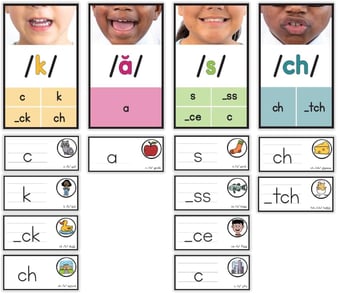
- Next, make sure the sound wall has mouth placement images. This is so crucial for our beginning readers, ELL students, and any other student needing extra visual support. Look for images that clearly show mouth positions for producing each sound because it helps students learn proper articulation.
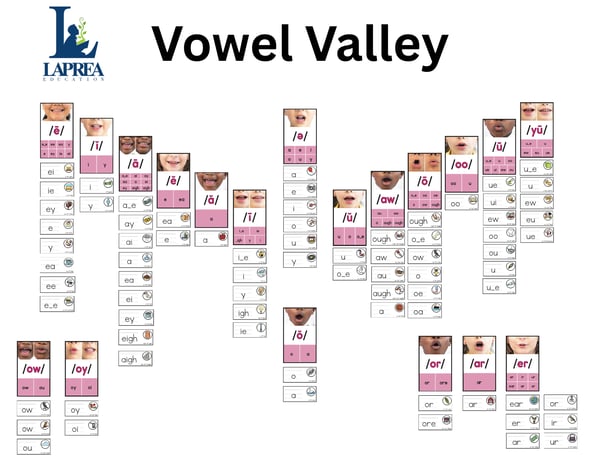
- In addition, I really want to see meaningful color coding that distinguishes the place of articulation, helping students categorize and remember sounds. The consonants in my sound wall are color-coded by place of articulation, and the vowels are categorized as one color so you can easily pull them out and make them into a vowel valley.
- Now, this next one is a biggie. I look for the perfect-sized sound wall. Choose a size that is large enough for students to see and reference from across the room but compact enough to fit all sounds without overwhelming the space.
- Most crucially, make sure the sound wall is compatible with your phonics program. Some programs recognize more than 44 sounds, and others categorize their sounds a little differently, especially when it comes to r-controlled vowels. Just make sure that what you’re using supports the material you’ll be teaching students.
- Now, some phonics programs come equipped with a sound wall; others don’t. And some classrooms are incorporating a sound wall without a formal, printed curriculum. In this case, look for a sound wall that comes with comprehensive teaching notes. These should provide guidance on teaching articulations, common errors to watch for, and corrective feedback strategies.
- And some other odds and ends to consider … choose a sound wall made from durable materials that can withstand frequent use and handling by both teachers and students. Select a sound wall with an appealing and engaging design to capture students' interest and make learning fun.
By considering these features, you can choose a sound wall that supports literacy instruction in your classroom.
Our sound wall has all of these wonderful features … I mean, at the time when I was doing my own research, I literally had to make my own in order to check all these boxes. If you are in search for a quality sound wall, there are a couple of places you can get your hands on this one.
First, check out the link below to access this sound wall as well as a teaching guide on Amazon. Or, if you have purchased our Structured Literacy with E.A.S.E. program, this sound wall is included in your program materials, as well as over one hundred excellent reading lesson plans that cover all six strands of Scarborough’s reading rope. I’ll throw that link below, too, in case you are looking for easy-to-implement phonics lessons in your K-2 classroom––or even 3-5 for those kids who still need intensive phonics instruction.
Also, if you want to learn more about sound walls, and structured literacy in general, and the body of research that informs our teaching practices today, check out our FREE course, The Science of Reading Academy, a 6-module course that covers the science of reading research, from the history of reading instruction to the frameworks that underlie reading instruction, to how the brain learns to read, practical tips for teaching word recognition and language comprehension in your classroom, and practical tips for teaching your ELLs and using assessments. I’ll put that link below as well. As teachers, we’re always learning, aren’t we?
Thanks for watching, and happy teaching! Don’t forget to like, subscribe, and hit that notification bell for more tips and tricks for your classroom. See you next time!
Now Available on Amazon - Sound Wall: https://www.amazon.com/dp/B0DNQ7F46D
Laprea Education Shop.: https://lapreaeducationshop.com/
FREE Science of Reading Academy: https://scienceofreadingacademy.com/
References:
- Birsh, J. R. (2011). Multisensory Teaching of Basic Language Skills.
- Bransford, J. D., Brown, A. L., & Cocking, R. R. (2000). How People Learn: Brain, Mind, Experience, and School.
- Ehri, L. C. (2005). Learning to read words: Theory, findings, and issues. Scientific Studies of Reading.
- Ehri, L. C., Nunes, S. R., Willows, D. M., et al. (2001). Phonemic awareness instruction helps children learn to read: Evidence from the National Reading Panel's meta-analysis.
- Echevarria, J., Vogt, M. E., & Short, D. J. (2017). Making Content Comprehensible for English Learners: The SIOP Model.
- International Dyslexia Association. (2002). Definition of Dyslexia.
- Moats, L. C. (2020). Speech to Print: Language Essentials for Teachers.
- National Reading Panel. (2000). Teaching Children to Read: An Evidence-Based Assessment of the Scientific Research Literature on Reading and Its Implications for Reading Instruction.
- Tomlinson, C. A. (2001). How to Differentiate Instruction in Mixed-Ability Classrooms.
- Zimmerman, B. J. (2002). Becoming a Self-Regulated Learner: An Overview. Theory into Practice.
.png?width=960&length=960&name=Landing%20Page%20Backgrounds%20(5).png)